ISLAMABAD (Big Digit) Pakistan–China Relations: History, Strategic Trust, and Political, Economic and Civilizational Significance


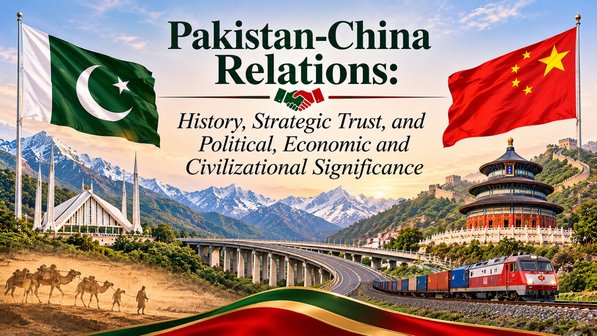
Written By Ms. Moazma Gul Awan, a Participant of ICSF-SBBWU Fellowship Programme 2026-2027
ISLAMABAD (Big Digit) The relationship between Pakistan and China is one of the oldest and most important bilateral relationship in the modern world of international politics. Diplomatic ties between the two sides have been established since 1951 and the friendly ties between the two sides have been step by step moving towards a comprehensive strategic partnership. Throughout the decades, the two sides have enhanced their cooperation with political contacts, economic exchanges, defence cooperation, exchanges in education and culture.
The relationship is officially called an All-Weather Strategic Cooperative Partnership. Continuity of their bilateral cooperation in changing regional and international circumstances is underscored by the term all-weather. Both countries are also referred to as Iron Brothers, reflecting their traditional friendship, mutual trust and strategic cooperation.
The historical basis of the relations between Pakistan and China goes back to the beginning of the People’s Republic of China. Pakistan recognised the new Chinese government on 5 January, 1950, one of the first countries to do so, after the establishment of People’s Republic of China on 1 October, 1949. But, diplomatic relations between the two countries were formalised on 21 May 1951. The act initiated the official diplomatic contacts and ushered in a new era in bilateral relations.
Diplomatic relations slowly grew in the 1950s. In 1956, the Prime Minister of Pakistan Hussain Shaheed Suhrawardy visited China and Chinese Premier Zhou Enlai visited Pakistan. The high-level exchanges helped to deepen understanding and cooperation in the diplomatic field.
In 1963, a crucial milestone was reached with the signing of a boundary agreement between Pakistan and China, which was negotiated between the two countries. The pact helped to determine the border of the Chinese region of Xinjiang and neighbouring territories controlled by Pakistan. It showed the value of peaceful negotiations and diplomacy in relations with neighbouring countries.
Pakistan International Airlines (PIA) launched its operations to Beijing in 1964 as the first airline from non-communist country to fly to the Chinese capital. This development reinforced the connectivity of transportation and people-to-people.
Another significant feat was the building of the Karakoram Highway (KKH) linking Pakistan with the Xinjiang region of China via the Khunjerab Pass. The highway became an important geographical and strategic link between the two countries. It was built in the late 1970s and opened in 1978.
The two countries signed a Joint Declaration on the Directions of Bilateral Cooperation in 2003, which gives more direction to their strategic relationship.
In April 2015, a new phase started with the visit of the Chinese President Xi Jinping to Pakistan. This visit saw both countries reaffirm their All Weather Strategic Cooperative Partnership. The visit also provided a great impetus to the China-Pakistan Economic Corridor (CPEC) which had been formally launched under an agreement in 2013.
There are several important factors that have contributed to the development of strategic trust.
Diplomatic relations: The two countries have continued to have regular diplomatic contacts, even though there have been changes in their political leadership and international situation.
Defence cooperation: They have enhanced their security partnership through military exchanges, joint exercises, professional training and defence technology cooperation.
Diplomatic support: Cooperation and consultations between the two States are taking place on important regional and international issues on a regular basis.
Respect for sovereignty: Their bilateral relationship officially emphasises mutual respect, territorial integrity, sovereignty and non-interference in internal affairs.
Institutional cooperation: There have been regular meetings, bilateral agreements and exchanges between the political and military leadership, which have laid the institutional basis for their partnership.
So, strategic trust is not just a diplomatic term or a political slogan. It is embodied in decades of institutional involvement, defence cooperation, diplomatic consultation and concrete cooperation.
But strategic trust does not imply that both countries have the same interests in all issues. Instead, it’s a sign of their capacity to remain cooperative with each other, and to manage their shared interests in a way that is mutually understood.
On the political front, Pakistan and China enjoy cordial relations with respect to each other’s sovereignty, mutual strategic interests, and stability in the region.
The two countries hold regular bilateral contacts and cooperation with one another in the framework of multilateral platforms, including the United Nations (UN) and the Shanghai Cooperation Organisation (SCO), which they both are members of.
China is critical for Pakistan’s diplomatic and strategic interests. It has a global political and economic impact, which makes it important for the foreign policy of Pakistan.
Another significant aspect of relations between Pakistan and China is economic cooperation. China is a key trading partner of Pakistan and a major source of investment especially in Pakistan’s energy and industrial development and infrastructure sector.
The most prominent economic project in this relationship is the China-Pakistan Economic Corridor (CPEC), a flagship project of China’s Belt and Road Initiative (BRI). The formal inauguration of CPEC took place in 2013 and the visit of Chinese President Xi Jinping to Pakistan in April 2015 gave a boost to its implementation.
It is meant to boost economic ties between the western part of China, especially Xinjiang and Pakistan, by developing transport infrastructure and energy projects, industrial development and Gwadar Port.
Infrastructure and transportation: Development and upgrading of roads, highways, railways and transportation facilities for trade and connectivity.
Energy: Planning of electricity generation projects and energy infrastructure to meet the energy needs of Pakistan.
Gwadar Port: Development of Gwadar Port as an important maritime and commercial centre, providing opportunities for regional trade and connectivity.
Industrial cooperation: Special Economic Zones (SEZs) for promotion of industrialisation, investment, manufacturing and employment.
Agriculture: Cooperation in modern farming methods, agricultural research, technology and agricultural productivity.
Technology and digital development: Telecommunications, digital infrastructure, technological innovation and information technology.
CPEC is of economic importance as it links with the Chinese West and the transportation and maritime infrastructure of Pakistan. It also opens up possibilities for the trading of goods between South Asia, Central Asia and the rest of the world.
But, the success of CPEC hinges on effective implementation, transparency, financial sustainability, security and local participation and economic benefit distribution.
In this manner, the economic cooperation between Pakistan and China transcends the realm of normal business transactions. It is a part of a larger push for infrastructure, investments, regional connectivity and economic growth.
The relations between Pakistan and China are not just limited to the current diplomatic treaties and economic ties. Both countries share a history of centuries of trade, travel, cultural exchange and the transfer of ideas that is part of a larger Asian historical experience.
The Ancient Silk Road is a very important historical link as it was a network of trade routes connecting various regions of Asia, including China to Central Asia and the present day Pakistan. These routes helped to spread goods, knowledge, religion, technologies and cultural practices.
The other significant historical link is that of the Gandhara Civilization that blossomed in the regions of what is now Pakistan, especially in Taxila and the Peshawar Valley. Gandhara became an important centre of Buddhist art, learning and religious activities.
Buddhist ideas from the Gandhara area spread towards central Asia and China through the efforts of Buddhist scholars, monks and travellers. All of the above historical encounters highlight the significance of the area which is today Pakistan in the broader cultural and intellectual history of Asia.
It’s crucial to realize that these ancient ties predate the creation of modern Pakistan and China. Despite this, they serve as a historic basis for cultural diplomacy, cultural heritage protection, tourism and academic research between the two nations.
Education is also a significant linkage between the Pakistani and Chinese society. Increasingly, Pakistani students are studying in Chinese universities, especially in the fields of science, engineering, medicine, technology and social sciences.
Programmes on Chinese language and cultural exchanges, academic conferences, educational scholarships, and university partnerships help to enhance understanding between the young people.
In the same way, cultural festivals, exhibitions, tourism and academic exchanges can be occasions for citizens of both societies to gain insights into the other’s traditions, values and history.